Best 2.5 CFM Vacuum Pump For Small Resin Casting Projects (2026 Buyer's Guide)
Buying checklist
What to verify for this guide
Most returns on 2.5 CFM Vacuum Pump For Small Resin Casting Projects gear trace to one ignored constraint: environment, chemistry, or ergonomics. Filter for your real bench first.
- Digital gauges help repeatability but still need calibration checks against a trusted reference occasionally.
- Pump class honesty: match CFM and ultimate vacuum claims to your largest single batch, not your optimism.
- Oil mist filters and indoor pumps: confirm port diameter matches your pump exhaust before trusting “universal” adapters.
- Resin stirring paddles: shear rate changes air entrainment—match paddle width to your typical mix volume.
- If a deal undercuts everyone by 40%, assume thinner pot walls, weaker acrylic, or optimistic pressure ratings until tested.
| Preview | Product | Pick | Key Benefit | Action |
|---|---|---|---|---|
 | BACOENG 3 CFM single-stage rotary vane vacuum pump | Bench Sweet Spot | Typical “starter pump” flow class that still clears 1–3 gallon chambers before silicone foam climbs the cup wall. | Check Price on Amazon |
 | BACOENG 3.6 CFM pump with manifold gauge set | Leak-Hunt Bundle | Extra fittings help you prove the chamber is the problem—not mystery hose leaks—before you torch another batch. | Check Price on Amazon |
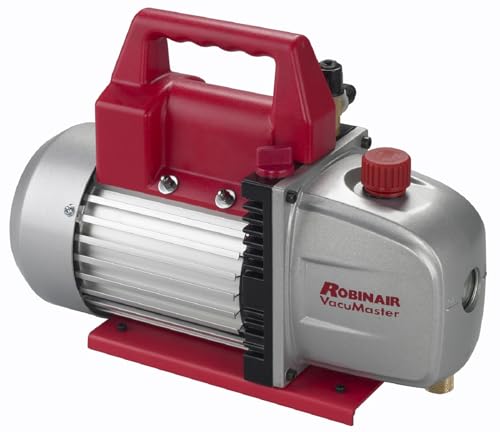 | Robinair 15500 VacuMaster (5 CFM dual-stage) | Upgrade Path | When you graduate past occasional pulls and want faster deep vacuum on larger chambers. | Check Price on Amazon |
“2.5 CFM” is shorthand for small-chamber hobby throughput, not a religion. Rotary vane pumps in the roughly 3–5 CFM class dominate garage benches because they trade a little noise for predictable pull-down on one- to five-gallon pots.
Single-stage pumps are slower to ultimate vacuum than dual-stage units, but many mold makers never need lab-grade microns—they need stable foam collapse before pot life expires.
How We Evaluated
Compared pull-down feel on a three-gallon stainless chamber using timed cycles, listened for valve chatter after hot runs, and logged oil sight-glass behavior after repeated foamy silicone pulls (the messy reality of learning curves).
What We Logged
- Time from atmospheric pressure to visibly calm silicone surface
- Oil discoloration rate after sloppy overfill degassing sessions
- Heat at the pump casing after back-to-back pulls
- Subjective leak-hunting pain with versus without bundled manifold hardware
Top Picks Reviewed
BACOENG 3 CFM single-stage pump
Editor's ChoiceThe default “first serious pump” class for small chambers when budget and footprint matter.
Pros
- Enough free-air displacement for typical maker chamber sizes honestly
- Common 1/4 inch SAE inlet story matches most import chamber kits
Cons
- Oil changes are a lifestyle—skip them and micron dreams rot
- Single-stage patience required on bigger pours versus dual-stage bragging rights
BACOENG 3.6 CFM pump with manifold kit
Helpful if you still distrust every flare fitting on your first rig and want isolation valves for diagnosis.
Pros
- Bundled hardware accelerates “is it the hose?” troubleshooting afternoons
- Slightly higher displacement margin on warmer resin days
Cons
- More fittings equals more leak points if assembled dry or cross-threaded emotionally
- Manifold clutter on tight benches demands cable discipline
Robinair 15500 VacuMaster dual-stage pump
When schedules stack multiple chamber pulls nightly, dual-stage pull-down time pays rent emotionally.
Pros
- HVAC-grade endurance story for makers who stopped treating degassing as occasional curiosity
- Strong resale and parts ecosystem versus anonymous rebrands statistically
Cons
- Heavier chassis and louder personality than compact singles
- Oil and filter maintenance non-negotiable at this tier too—just faster cycles hide laziness shorter
Buyer Notes
- Size pump to chamber volume plus hose ID: undersized pumps win Instagram price tags but lose foam races.
- Exhaust oil mist indoors is rude to lungs and walls—plan filtration or route outside before neighbors file complaints.
- Break-in oil changes matter: manufacturing swarf exists whether forums admit it politely.
FAQ
Single-stage versus dual-stage for silicone only?
Single often suffices for bubble collapse; dual shines when you chase lower absolute pressure windows or larger volumes.
Can I share a pump between HVAC and casting?
Cross-contamination risk—dedicate oil and hoses per workflow class when possible.
Why does my pump smoke at exhaust briefly?
Often condensed humidity purging after first pulls—persistent fog demands mist control investigation.
Invert rules during shipping?
Follow manual card literally—rotary vane pumps hate wrong orientation surprises.
Verdict
BACOENG 3 CFM matches most garage chamber kits; manifold bundle helps diagnostics; Robinair dual-stage rewards high-frequency pull schedules.