Best Gravity Feed Airbrush For Miniature Painting Detail Work (2026 Buyer's Guide)
| Preview | Product | Pick | Key Benefit | Action |
|---|---|---|---|---|
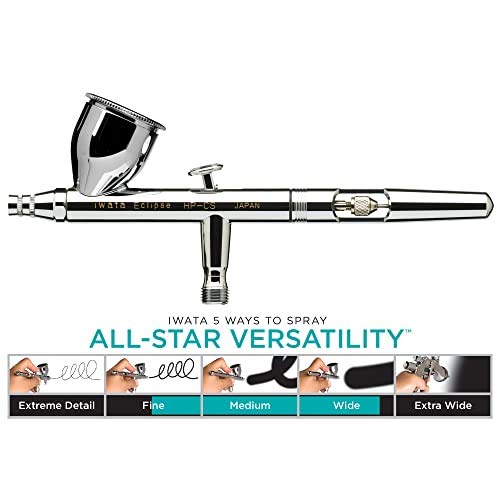 | Iwata Eclipse HP-CS (0.35 mm) | Editor's Choice | The usual “buy once” midpoint: forgiving enough for base coats, precise enough for panel lines when thinned cleanly. | Check Price on Amazon |
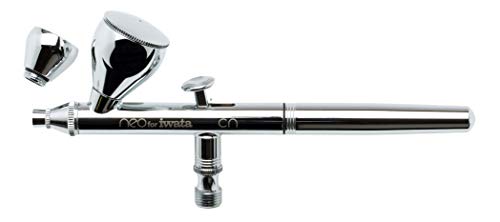 | Iwata Neo CN Gravity | Best Budget | Real gravity-feed ergonomics without paying for micron-level machining you may not exploit yet. | Check Price on Amazon |
 | Harder & Steenbeck Evolution CRplus | Upgrade Path | If you chase soft blends and repeatable micro-lines, this is where trigger modulation starts to feel “locked in.” | Check Price on Amazon |
Miniatures punish vague paint control: half a millimeter of overspray reads as sloppy edge highlight. Gravity cups keep pigment close to the tip, so thinning and pigment load change what you see on the model faster than with siphon rigs—exactly why most painters standardize here after their first bottled-color phase.
How We Tested
Sessions used the same thinning ladder (thin → standard → slightly heavy) across three repeatable exercises: zenithal undercoat at low psi, glaze-style transparency passes, and a tight line along raised edges. Swap rules: same compressor regulator, same distance, timers on teardown.
What We Measured
- Trigger double-action modulation (paint-on vs air-on independence)
- Line width repeatability across three consecutive refill cycles
- Cold-start behavior after idle (tip dry tendency with hobby acrylic)
- Minutes to fault-free flush after metallics vs flat pigments
Top Picks Reviewed
Iwata Eclipse HP-CS
Editor's ChoiceThe practical standard: wide enough nozzle to stay productive on troops, disciplined enough at low psi for directional highlights when your thinner is filtered.
Pros
- Parts and tutorials are everywhere in US hobby channels
- Handles both aqueous acrylic and occasional lacquer if you segregate flushing
- Less finicky needle seating than ultra-fine detail heads
Cons
- 0.35 mm still will not mimic a true micron brush for illustration hairlines
- Premium price sting if you are only batch-priming infantry
Iwata Neo CN Gravity
Keeps gravity-feed fundamentals—proper cup angles, workable trigger travel—without the cost of chasing museum-grade internals on day one.
Pros
- Low enough buy-in that practice hours do not feel “expensive mistakes”
- Still rewards good thinner discipline like any serious brush
- Spare needles cost less sting when learning repair
Cons
- Fine control ceiling is visibly below Eclipse-class when you feather edges
- Plastic trim and ergonomics feel more “studio rental” than “lifetime tool”
Harder & Steenbeck Evolution CRplus
For painters who narrate blends in strokes per millimeter: self-centering nozzle philosophy and very linear trigger response versus many Asia-market competitors.
Pros
- Cleaning cycles feel shorter once you learn their nozzle-stack habit
- Ecosystem of cups and nozzle sizes postpones replacing the entire body
- Strong second brush if Eclipse is already your “workhorse width”
Cons
- Sticker shock if you skip straight from an Amazon bundle kit
- Fine setups still demand distilled water tiers and retarder—you cannot shortcut prep
Buyer’s Guide (What to Look For)
- Needle/nozzle pairing printed on packaging is not interchangeable trivia—mis-matched sets cause chronic sputter.
- Cup size vs session length: 5–10 ml gravity cups dominate minis work; gigantic cups skew balance.
- Seals and solvents: plan lacquer workflows only if fluoropolymer seal paths are credible for that SKU.
- Spare needles in-stock matter more than the brush’s showroom shine; minis bends happen at 02:00 on Sunday.
Setup and Maintenance
Before the first mini
- Establish a thinning note (weight or ratio) tied to PSI—do not freestyle each session.
- Run clear reducer through until atomization snaps into a tight cone without “halo spit.”
After metallics or whites
- Back-flush with reducer before pigments plate in the nozzle crown.
- Lubricate sparingly along manufacturer guidance; overlubrication grabs dust.
Red flags mid-army batch
- “Hollow” hiss with no paint usually means clogged fluid tip, not magically empty cup.
- Dots rather than lines after cleaning often mean a chipped needle—not more psi.
FAQ (From Real Maker Questions)
Do I really need gravity for 28 mm figures?
No law requires it—but siphon excels when you churn huge color changes; gravity wins when pigment load and trigger nuance dictate edge quality across one figure for an hour.
Why does my eclipse-sized brush still spider at low psi?
Almost always viscosity or dusty paint film. Raise flow slightly or filter; raising psi alone often just moves the spiders outward.
Is a gravity brush enough for varnish top coats?
Yes, provided you thin to a skim-milk feel and dust-nuke the booth; many failures are surface contamination, not brush class.
When should I add a micron-class tool?
When your reference photos demand hair-width separation and Eclipse-class lines still read chunky at your best thinning—not before fundamentals stabilize.
Who This Is For
- Hobbyists leveling up from handheld brush base coats who want repeatable priming plus controlled highlights.
Who Should Skip This
- Production painters who genuinely prefer large-volume siphon color libraries and seldom touch gravity ergonomics.
Verdict
Buy the gravity head that survives your thinning discipline—the Eclipse HP-CS if you want one brush to carry infantry and heroes, Neo if you refuse to subsidize ego while practicing, Evolution if blends already frustrate you on an otherwise “fine” brush.