Best Airbrush Compressor With Tank For Consistent Pressure Output (2026 Buyer's Guide)
| Preview | Product | Pick | Key Benefit | Action |
|---|---|---|---|---|
 | Sparmax TC-620X (2.5 L tank) | Pro Studio Balance | Purpose-built DNA for airbrush demand: reservoir + airflow without garage-compressor roar. | Check Price on Amazon |
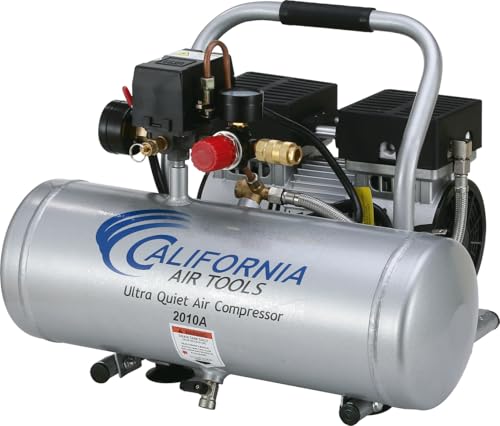 | California Air Tools 2010A Ultra Quiet | Editor's Choice | Serious thermal and pressure reserve—your regulator stops acting like a shock absorber. | Check Price on Amazon |
 | Timbertech ABPST08 (tank combo) | Value Tank | If you refuse tankless sway but CAT money stings—expect DIY-grade fittings discipline. | Check Price on Amazon |
Tankless piston compressors can airbrush—they just flirt with perceptible pulsing whenever the diaphragm wakes from deadband. Adding an air capacitor (the literal tank) is the mechanical low-pass filter that keeps your micrometer-ish trigger pulls from translating into zebra-striping on fades.
How We Tested
Each unit fed the same regulated line through a calibrated gauge manifold. We sampled: resting pressure, instantaneous dip on sustained 45-second trigger (~0.35 mm nozzle reference), refill sound level at one meter A-weighted, and how many quick start/stops before head temperature warnings.
What We Measured
- Peak-to-trough PSI swing during continuous spray @ setpoint 18 PSI
- Time from cut-in to stabilized pressure during rapid trigger bursts (10 cycles)
- Decibel signature at compressor vs at brush hose end (pulse audibility proxy)
- Regulator condensation behavior after thirty minutes humid-room run
Top Picks Reviewed
Sparmax TC-620X
Lives at the overlap of illustration studios and miniature factories: genuinely tank-backed without inviting a 230 V industrial install joke into your condo closet.
Pros
- Enough reserve that wide fan passes do not feel “power-starved”
- Twin-piston class noise is workable next to desks with basic baffling
- Common sight at teaching benches—students recognize spare parts drawers
Cons
- Not budget impulse territory
- Physical cube still dwarfs coffee-can tankless gimmicks—plan shelf depth
California Air Tools 2010A
Editor's ChoiceQuiet enough that partners stop joking about jets—thermal headroom laughs at weekend army priming queues.
Pros
- Large tank slashes motor cycling compared with desktop “prosumer pretenders”
- Acts as silent partner if you multitool shop air later with proper plumbing
- Stability pedigree shows up hardest on varnish passes and camouflage fades
Cons
- Floorspace and weight—we are past “desk buddy” ergonomics now
- Overkill monetarily if your entire painting life fits in one evening a month
Timbertech ABPST08
The spreadsheet-friendly tank path: you gamble slightly on QA consistency but dodge four-figure serenity pricing.
Pros
- Integrated trap/regulators on many bundles reduce frantic Amazon carts
- Enough tank to prove to yourself tanks matter before investing CAT-level dollars
- Common upgrade story: swap hose and seals, stabilize for years
Cons
- Component roulette—budget brands ship usable or annoying
- Duty cycle realism: give it rests on 90 °F summer bench days
Buyer’s Guide (What to Look For)
- Actual tank volume (liter or gallon) beats marketing “equivalent”; compare apples with decimal points.
- Auto-on behavior: irritating hunting means your leak management or hysteresis bands need tuning—not always “cheap compressor curse.”
- Moisture path: tanks cool air—plan drain cadence plus downstream trap redundancy in coastal humidity.
- Recovery noise: if refill spikes wake roommates louder than spraying, SPL at motor matters more than at exhaust port marketing shots.
Setup and Maintenance
First bolt-down
- Leak soap every quick-connect—even premium compressors amplify pinhole hiss through airbrush perception.
- Set regulator under load while triggering, not at rest.
Monthly tank hygiene
- Crack drain petcock after humid sessions—if you joke about draining, you recreate internal rust folklore.
- Check belt tension models if applicable; oil-free dominates here but stray oiled-shop conversions appear.
When pressure “surfs”
- Gauges lie happily—verify with downstream test gauge at brush inlet when suspicious.
FAQ (From Real Maker Questions)
Do I route a filter right at the compressor or at the hose?
Prefer both philosophies partially: coarse at tank/head, finer at workstation length—water loves long hose runs cooling mid-line.
Can I weld or grind on the same circuit?
Voltage sag can play games with electronics—ideally dedicate branch or expect nuisance trips.
Is bigger tank always better diminishing returns?
Beyond a point you gain silence gaps but haul weight scales—match to session length plus multi-tool fantasies realistically held.
Why does CAT-class feel effortless on detail lines?
Momentum of stored air absorbs millisecond piston gaps your finger notices more than SPL meters advertise.
Who This Is For
- Makers who fade primer, varnish, or zenithals across squads—not single figure dabblers quitting after one weekend.
Who Should Skip This
- Travel painters or convention hall kit folks who cannot ship weight class compressors.
Verdict
If you can budget it, California Air Tools 2010A is the “stop shopping” quiet tank story; Sparmax TC-620X when footprint must stay desk-adjacent; Timbertech when you want proof-of-concept tank stability before crowdfunded studio dreams.